.png)
Why Do I Feel Guilty Having My Own Feelings? Check Your Trash
The Half-Bath Trash Can Lives in All of Us

One of my clients told me recently that she was ready to take out the trash.
She was in a genuinely good place — better than she'd been in a long time. I wondered if there was a weight left over from everything she'd been through, still living somewhere in her body.
That feeling — nothing's wrong, but something's not right either — is one of the most common things I hear from the women I work with. And it almost always means the same thing: the trash hasn't been taken out in a while.
Another client jokingly referred to it as the half-bath trash can.
If you've ever felt guilty having your own feelings — like your emotions are somehow an inconvenience, a burden, too much — I want to talk about that half-bath trash can.
The Half-Bath Trash Can Lives in All of Us
You know the one. The little bathroom bin you half-empty, where there's always a wrapper or two left at the bottom. You see it. You move past it. You mean to deal with it later.
That's not a hygiene issue. That's most women's emotional lives.
You're not drowning. You're not in crisis. You're walking around with a trash can that's perpetually half-full, never quite emptied, somehow still accumulating. The frustration with the comment your mother made three weeks ago. The thing your partner said that you let go because it wasn't worth the conversation. The disappointment you swallowed because everyone needed something from you that day.
It adds up.
Here's what I know from my own life and from watching this happen with the women I coach: the reason the trash doesn't get taken out isn't that you don't care. It's that somewhere along the way, you learned your feelings take up too much space.
You were the one who kept the peace. The one who held things together. And holding things together meant not adding your own feelings on top of everything else.
So you swallowed. You pivoted to gratitude. You told yourself it wasn't a big deal.
That habit has prettier names. We call it resilience. We call it perspective. But a lot of the time, it's a trash can nobody ever empties.
Why Do I Feel Guilty Having My Own Feelings?
Because You've Been Taking Out Everyone Else's.
When love is your superpower — when you're genuinely the person people lean on, the one who notices and shows up — that strength comes with a bias.
You get so practiced at holding everyone else's feelings that you stop making room for your own.
Call it an overused strength, not a character flaw. The same quality that makes you an extraordinary friend, mother, or partner is so well-exercised that the corresponding muscle — the one that says my feelings matter too — barely gets used.
So when frustration rises in you, when you feel that flicker of anger or resentment or plain old exhaustion, a voice arrives with it: You have no right. Everyone's doing their best. Don't make this harder.
That voice is just the trash talking.
The Three Trash Cans
Once you see this framework, you can't unsee it.
The half-bath trash can — the stuff you're vaguely aware of. Low-grade frustration, minor resentments, the feelings you nodded at and moved past. You know it's there. You're not doing anything about it right now.

The kitchen trash — the medium stuff. The conversation you need to have. The boundary you haven't set. The slow-building anger at a situation that's been going on for weeks. You pull it out sometimes, think about it, put it back.

The outdoor trash by the garage — the big stinky stuff. The bin around the corner you don't even walk past. A relationship wound that never healed. A chapter of your life that deserves grief you've never let yourself feel. In summer heat, this one festers.

All three need to be taken out.
Missing trash day doesn't make anything disappear. The feelings don't dissolve because you're busy. They live in your body — your shoulders, your jaw, your three-a.m. wake-ups — until you give them somewhere to go.
What Taking Out the Trash Actually Looks Like
A client came into a recent session lighter than I'd seen her in months. She'd been listening to a podcast that suggested writing down everything she was angry about — no structure, no plan, no intention to send it anywhere. She sat outside and wrote every way she was angry at her parents. Past and present, petty and real.
"It was the most freeing thing I'd done in a while," she told me.
She hadn't confronted anyone. Hadn't solved anything. She'd gotten it out of her body and onto a page. She took out the trash.
In one of my coaching groups, another woman described wanting to hit the empty-trash button on her computer — to watch it all disappear permanently. I told her what I believe: there's always something on the hard drive. There's always a wrapper left at the bottom of the half-bath. The goal isn't to be empty. The goal is to take out what's accumulated before it festers.
The Permission Piece
What most of the women I work with are missing isn't a strategy. It's permission.
Permission to be frustrated, even when no one else seems to be. Permission to sit with grief before it moves to gratitude. To take up emotional space without apologizing for it.
You weren't taught that your feelings are worth taking out. You were taught they were the trash — inconvenient, too much, better managed away.
Taking out your own trash isn't selfish. Ask your body what happens when you don't.
So here's my question: when did you last check which can is full?
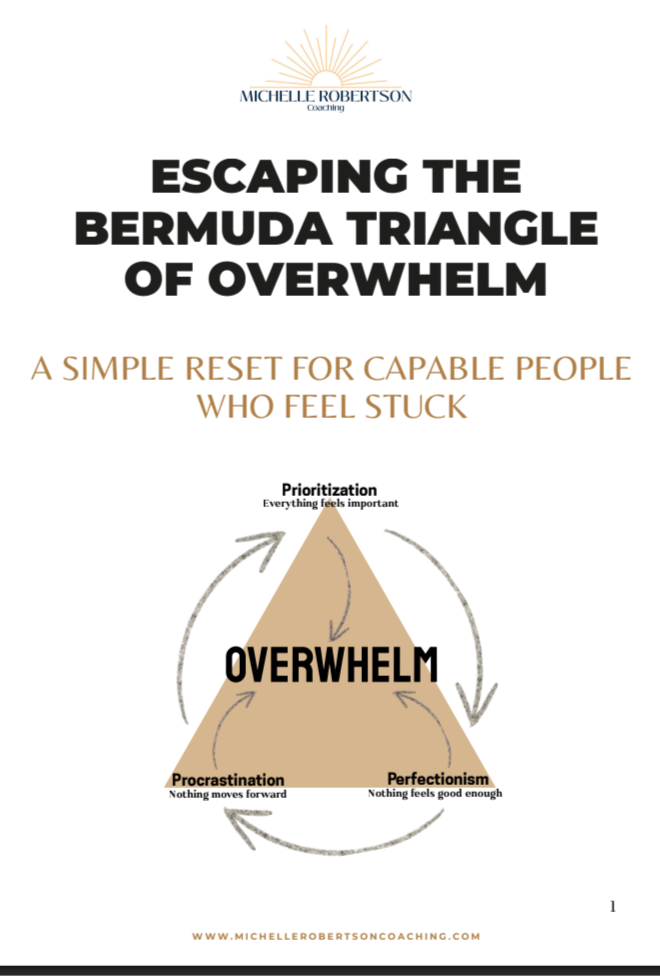
If you want a place to start, my Bermuda Triangle of Overwhelm Workbook helps you name what's actually pulling on you — which is often the first step to figuring out what's been sitting in your trash a little too long.


Comments